I have been volunteering as long as I can remember, as early as boyhood day when I was a boy scout day. I undersatnd volunteering as doing something for no reward, to imporive of livelyhood of a person and or society, and I do believe that volunteering is a vital aspect of human development that should be enshrined in the hearts and minds of every person as they grom up.
However, I sometimes see volunteering being used as cover up by weak institutions and government or failed states who cannot provide the basic needs a tax paying community deserves. Obviously this does not include times of natural disasters like 3/11, droughts as in Somalia etc... But in normal circumstances with tax paying citizens, and all the health, eductaion, sanitary etc services being done by volunteer, whlist corrupt officials embezell government coffers. This is particurlarly true of most third world countries.
2011年7月14日木曜日

Nuclear Society Blog Post
I think in any serious argument about Nuclear energy today. the most politically correct side to be would the anti nuclear side. So natural result in this atmosphere is the downplaying the uses and importants of nuclear energy * nuclear health, cheap energy, envronmenatally friendly energy, technologically adavncing academic discipline*, what we only concentrate on are the negative things *radio-active contamination, uranium disposal, Fukushima Dai Ichi, Chernobyl etc.
I think a much wiser view would be to appreciate though fair and sound evaluation of the both the good and bad aspects of nuclear energy. I am not saying that the negative aspects of nuclear energy should be ignored, no not at all, They are very serious and cannot be ignored. I am only saying that they should be weighed without predertemined conclusions or special interests in mind.
I think a much wiser view would be to appreciate though fair and sound evaluation of the both the good and bad aspects of nuclear energy. I am not saying that the negative aspects of nuclear energy should be ignored, no not at all, They are very serious and cannot be ignored. I am only saying that they should be weighed without predertemined conclusions or special interests in mind.
Media Repersentation Group Blog Response
When the 3/11 disaster struck, I had just into a new apartment a few days earlier, so did not have a TV set and internet access as yet.
My main source of information was through friends and Japanese mass media like Newspapers and the daily updates I saw on Train TV news.
Whenever I got acces to the internet and TV, I really did not trust what the foreing media especially Fox News and CNN, as they seemed to blow everything out of proportion by their dramatic exaggerations.
I am not a very big fan of social medis sites, so did make any use of Facebook. twitter etc..
My main source of information was through friends and Japanese mass media like Newspapers and the daily updates I saw on Train TV news.
Whenever I got acces to the internet and TV, I really did not trust what the foreing media especially Fox News and CNN, as they seemed to blow everything out of proportion by their dramatic exaggerations.
I am not a very big fan of social medis sites, so did make any use of Facebook. twitter etc..
2011年6月21日火曜日
Diplomatic Reaction Blog assignment
As a citizen of Zimbabwe, which is represented by the Embassy of Zimbabwe in Japan which is under the umbrella of the African Diplomatic Corps, ADC, in Japan. I really got a tremendous amount of help from both the embassy of Zimbabwe and the African Diplomatic Corps.
They were the sort of gospel for me to stay in calmly and comfortably in Japan. Their constant communications through emails, on the development of the situation in Eastern Japan, especially that of the Fukushima Power Plant, was very regular and always up to date. Even at times when there was nothing new to say, they communicated that there was nothing new to report, and alwasy assured us to be calm and take as many precautionary measures as possible but to always react appropriatley and in accordance to the needs of the situation. Which most of us did. I highly congratulate on them on a job well done.
Given the graveness of the situation then, their and everyone elses limited expertise on dealing with such great disaster of such magnitude, lack of resourses and havoc in communication lines, I think that they did a great job that they need to be commended on.
I think the co-operation that my embassy and the African Deplomatic Corps had with the Japanese authorities, went a long way to bolster relationships in tyhe future.
They were the sort of gospel for me to stay in calmly and comfortably in Japan. Their constant communications through emails, on the development of the situation in Eastern Japan, especially that of the Fukushima Power Plant, was very regular and always up to date. Even at times when there was nothing new to say, they communicated that there was nothing new to report, and alwasy assured us to be calm and take as many precautionary measures as possible but to always react appropriatley and in accordance to the needs of the situation. Which most of us did. I highly congratulate on them on a job well done.
Given the graveness of the situation then, their and everyone elses limited expertise on dealing with such great disaster of such magnitude, lack of resourses and havoc in communication lines, I think that they did a great job that they need to be commended on.
I think the co-operation that my embassy and the African Deplomatic Corps had with the Japanese authorities, went a long way to bolster relationships in tyhe future.
2011年6月7日火曜日
An interesting program on NHK NOW!!!
There is a very interesting program on NHK with expects from the IAEA, which I think is very to our course with Professor Watanabe.
2011年6月4日土曜日
Nuclear Power in Japan: the longer view (ByMARTIN DUSINBERRE)
Nuclear Power in Japan: the longer view
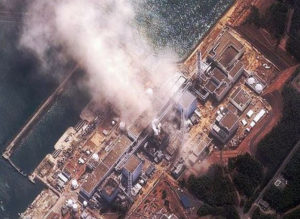
Explosions at Japan's Fukushima-Daiichi Nuclear Power Plant. Creative Commons/daveeza.
I imagine I’m not alone in looking at the apocalyptic images of north-eastern Japan in the last ten days and thinking, I wish I were a doctor of medicine or engineering, not one of history. Or, to put it more bluntly, a useful doctor, not a paper one.
Yet even historians have their uses at times such as these. Japan has suffered three disasters since 11 March, and thanks to the expertise of our scientific colleagues appearing in the media, most of us can now hold our own in basic conversations concerning not only tectonic plates and wave structures, but also fuel rods and cooling systems. Such knowledge is important, but we also need to know how Japan got here in the first place. Why did the only country in the world to experience the horrors of nuclear weapons in 1945 end up being the third-largest user of nuclear power by 2011?
Bald statistics highlighting the Japanese economy’s overdependence on crude oil imports from the Middle East in the 1960s and early 1970s go only so far in helping us answer that question. In addition to acknowledging Japan’s lack of natural resources, what we also need to grasp are the ‘cultures of technology’, such as those examined by Gabrielle Hecht in her study of the French nuclear power industry and post-war national identity. Moreover, with a similar focus on culture and social interactions—the bread-and-butter of historians’ work—we also need to study local politics in order to understand the rise of the nuclear power industry in post-war Japan. For as Tokyo bureaucrats had realized by the time of the 1973 Oil Shock, there would be no industry at all if local communities refused to host power plants. No nuclear power industry, and no high-speed economic growth.
This top-down focus on local communities in the late 1960s and 1970s was one means by which policymakers addressed Japan’s so-called ‘nuclear allergy’. The allergy was not only triggered by the bombings of Hiroshima and Nagasaki, but also by the Lucky Dragon incident in 1954, in which members of a Japanese fishing vessel were exposed to radioactive debris from US hydrogen-bomb tests on the Bikini Atoll. The plight of the fishermen, one of whom died within six months, captured the imagination of Tokyo housewives in particular, and led to the formation of the anti-nuclear movement in Japan. (The Lucky Dragon incident was also the inspiration for the 1954 blockbuster, Godzilla.) By targeting resources at local constituencies likely to oppose the arrival of nuclear power in their back yard—fishermen and housewives, for example—Tokyo hoped if not to overcome, then at least to manage the post-war nuclear allergy.
The new regime of subsidies available to host communities, the Three Power Source Development Laws (1974), also addressed a second problem in post-war Japanese society. Economic growth from the mid-1950s onwards may have been impressively high-speed, but it was unevenly distributed. By the time of the first Oil Shock, much of rural Japan had entered a depopulation crisis. For example, Kaminoseki, the small town in south-western Japan which I’ve studied, lost a third of its population between 1960 and 1975 alone, as young people in particular sought education and work in distant cities. Attempts to attract new investment by major corporations failed, leaving Kaminoseki politicians and bureaucrats ever more desperate in their desire to ‘halt’ depopulation. In the early 1980s, therefore, they struck on the solution of nuclear power, and the first vote to request a power plant (and the central government subsidies that would come with it) was made in 1984.
This was an example of what we might call Definitely In My Back Yard, rather than the more commonly studied phenomenon, Not In My Back Yard (NIMBY). But although Kaminoseki’s active pursuit of nuclear power was somewhat unusual, the arguments that made nuclear plants attractive to the majority of townspeople were nevertheless the same as those found in host communities throughout Japan. A power station would create jobs—less in the plant itself than in secondary industries, such as construction and services. Nuclear subsidies would bring new infrastructure, such as roads, schools, and care centres for the elderly. Nuclear subsidies would lead to lower municipal taxes and subsidised child care. In Kaminoseki, nuclear subsidies even funded the construction of a new town history museum.
In these ways, the debate about the pros and cons of atomic energy at a local level focused as much on questions of municipal survival as nuclear safety. In towns such as Kaminoseki, the risks posed to the community by population decline and resulting loss of identity were arguably more visible in everyday life than the abstract, future risks posed by a nuclear power station not yet built.
Even when safety issues were explicitly addressed, technological considerations were filtered by cultural and social interactions. For example, the electricity companies regularly took residents from potential host communities on ‘study visits’ of nuclear plants in other parts of the country. To participate in such a visit implied that one had ‘studied’ the issue; those who did not participate, and who questioned the scientific basis of the information on offer, could thus be labelled as having insufficiently ‘studied’ the issue. In the dispute between majority pro-nuclear and minority anti-nuclear campaigners in Kaminoseki, the pro-campaigners accused their opponents of lacking proper ‘understanding’ of safety issues. This focus on study and understanding merely polarized the debate over safety: either one understood the issue or one did not.
We should perhaps not go so far in insisting that the only true understanding of the nuclear crisis in Japan can come from studying post-war history. Nevertheless, any discussion of the post-Fukushima future of the Japanese nuclear industry will be incomplete without at least some understanding of Japan’s nuclear past. The legacies of Hiroshima, Nagasaki and the Lucky Dragon remain on the national psyche, as does Japan’s long-held desire for energy independence. But the dynamics and management of the nuclear power debate at a local level will be as equally important in determining how society responds to the nuclear crisis of 2011.
Martin Dusinberre is Lecturer in Modern Japanese History at Newcastle University. His first book,Hard Times in the Hometown: A Microhistory of Modern Japan, is forthcoming from the University of Hawaii Press: http://uhpress.wordpress.com/2011/03/18/
F
2011年5月31日火曜日
Commentary on an editorial about Nuclear Energy.
The recently held G8 summit which was held in France Libya and the Fukushima
I think the discussions on the Fukushima Nuclear Disaster, as the editor plainly pointed, were very sticky with all the member countries being huge beneficiaries of Nuclear Energy, especially France , America Fukushima Germany
The truth is that nuclear energy will constitute a significant chunk of our energy pie, so long we do not have another form of energy to match in volume, economical cost, environmental cost and ,yes, safety. Unless we can answer all the questions on cost, environment and volume, nuclear energy will still be lighting our homes and factories in a millennium. I am sure the so called Nuclear Summit, announced by Naoto Kan
http://www.yomiuri.co.jp/dy/editorial/T110528002300.htm
登録:
投稿 (Atom)